- Home >
- Public Procurement
Public Procurement in Madagascar
Public Procurement in Madagascar is a critical component of public financial management and government service delivery, particularly in infrastructure development, social services, and donor-financed investment programs. As a low-income economy with significant development needs, public procurement represents an important channel for mobilizing public and external resources.
Madagascar’s procurement system operates under a structured legal and institutional framework overseen by an independent regulatory authority. Public procurement activities are implemented by contracting authorities across central and decentralized levels, with a strong presence of development partner-funded projects.
For domestic suppliers, international contractors, and development-oriented firms, government tenders in Madagascar offer opportunities across works, goods, and consulting services, particularly in transport, health, education, agriculture, and public infrastructure.
Country & Economic Overview
| Country | Madagascar |
| Region | Sub-Saharan Africa |
| Population | 30,300,000 (2024) |
| Income Level | Low-income economy |
| Currency | Malagasy Ariary (MGA) |
| GDP | USD 16.8 billion (2024) |
| GNI | USD 16.2 billion (2024) |
| GNI per Capita | USD 540 (2024) |
Madagascar’s economy is characterized by a large agricultural sector, limited industrial base, and heavy reliance on public investment and international development assistance. Public procurement therefore plays a vital role in translating budgetary and donor resources into tangible development outcomes.
Public Procurement Governance Framework
The public procurement system in Madagascar is regulated by an independent oversight authority, while procurement execution is decentralized among contracting authorities.
| Public Procurement Agency (PPA) | Autorité de Régulation des Marchés Publics (ARMP) |
| Central Purchasing Body (CPB) | Not designated |
| Coverage | National |
| Institutional Role | Regulation, oversight, monitoring, and dispute resolution |
ARMP is responsible for ensuring compliance with procurement regulations, handling complaints, and publishing procurement statistics, while individual contracting authorities conduct procurement procedures.
Legal & Regulatory Framework
The public procurement law in Madagascar is governed by Law No. 2016-055 on the Public Procurement Code. This law establishes procurement methods, evaluation principles, and transparency requirements.
- Most Economically Advantageous Tender (MEAT): Provided for under Article 47.
- SME Participation: Encouraged under Article 28-III.
- Bid Securities: Regulated under Article 68.
- Public Bid Openings: Required under Article 35-IV.
- Domestic Preference: Permitted under Article 49.
The legal framework also establishes complaint procedures, standstill periods, and disclosure obligations aimed at strengthening fairness and accountability in public procurement.
Procurement Procedures & Thresholds
Procurement procedures in Madagascar are determined by contract value thresholds and specific procurement categories, as defined in the Public Procurement Code and related ministerial decrees.
- Open competitive tendering is the primary procurement method.
- Thresholds are defined under Article 6 and implementing decrees.
- Standstill and complaint periods are regulated under Title VIII.
- Contract award disclosure is required under Article 53.
Advertisement timelines for goods, works, and services are not uniformly specified in the law and may vary by procedure.
E-Procurement System in Madagascar
The eProcurement system in Madagascar operates through the national public procurement portal managed under ARMP supervision.
| System Name | Le portail des Marchés Publics malgache |
| Launch Year | 2010 |
| Primary Function | Electronic publication and notification of tenders |
| Language | French |
The platform focuses on transparency and information access rather than end-to-end electronic procurement transactions. Tender documents are generally not downloadable through the portal.
Procurement Market Characteristics
Public procurement in Madagascar covers a broad range of goods, works, and services, with a high proportion of contracts linked to externally financed development programs.
- Goods: Equipment, supplies, and imported materials.
- Works: Roads, public buildings, and infrastructure rehabilitation.
- Services: Consulting, supervision, and technical assistance.
Transparency, Complaints & Oversight
Madagascar’s procurement system includes formal complaint mechanisms administered under Title VIII of the Public Procurement Code. ARMP publishes procurement statistics and annual market results, contributing to oversight and public accountability.
Sustainability & Green Public Procurement
The current legal and institutional framework does not formally establish green public procurement strategies or mandatory environmental criteria within public procurement procedures.
Social & Ethical Procurement Considerations
While the procurement law includes provisions supporting SME participation, it does not establish explicit quotas or spend targets for women-owned or disadvantaged businesses. Ethical and labor considerations are typically addressed through donor-funded procurement requirements.
Key Challenges & Practical Insights for Bidders
- Limited institutional capacity in some contracting authorities
- Strong reliance on donor-funded procurement procedures
- Administrative and documentation requirements
- Language considerations for French-language tenders
Practical bidding tips
- Monitor ARMP publications and procurement statistics regularly
- Understand donor-specific procurement rules for financed projects
- Ensure compliance with formal bid security requirements
- Prepare French-language submissions where required
Overall, Public Procurement in Madagascar offers structured opportunities for qualified suppliers and contractors, particularly in infrastructure and development-focused sectors supported by international partners.
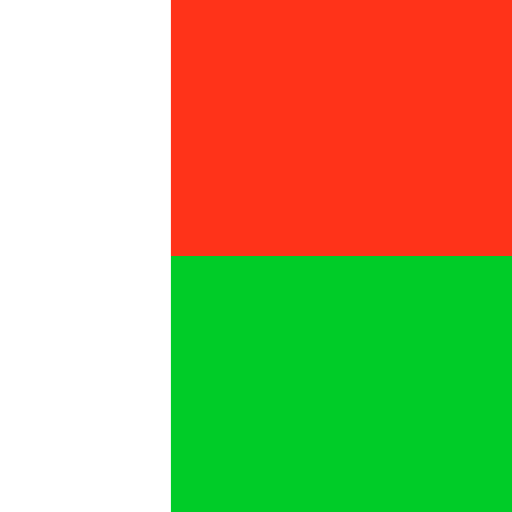
Flag of Madagascar